
The Toyota Steering Wheel Installation Guide
From the battery cable to the clock spring: how a Toyota steering wheel installation runs, the airbag steps that cannot be skipped, and the checks before a test drive.
Read More →Guide · 10/17/2026
How a Toyota paddle shifter upgrade works, from the GR Supra and GR86 to the Camry and RAV4: fitment, wiring, coverings and what to check before ordering.
Toyota builds the same automatic transmission into a Camry, a RAV4 and a GR Supra, and drivers use the paddles behind the rim in very different ways. Some want quicker control on a back road. Others simply want the wheel to look finished. A Toyota paddle shifter upgrade covers both aims, but the details differ from one car to the next.
The paddles sit behind the rim and let the driver choose a ratio without moving a hand from the wheel. With an automatic, they hold the gear you select until the box decides otherwise. On a car with a continuously variable transmission, the paddles step through preset ratios rather than real gears.
Both arrangements share one thing: the paddle is a switch, and the wheel it sits on has to carry the cut-out for it. This is why the upgrade is usually tied to a retrim rather than sold as a separate part.
Drivers who use the paddles regularly tend to hold the rim differently. The hands sit a little lower, with the fingers resting near the cut-out rather than across the spokes. A wheel built with that in mind feels natural from the first drive.
Paddle fitment follows the trim more than the model. Higher trims of several Toyota ranges offer them, and the table below sets out where owners usually find them.
| Model | Typical position | What usually matters |
|---|---|---|
| GR Supra | Fitted as standard | Paddle shape and mounting points |
| GR86 | Automatic cars | Cut-out position on the rim |
| Camry | Higher trims | Whether the car was ordered with them |
| RAV4 and Corolla | Trim dependent | Transmission type and wheel frame |
Because the answer changes by trim and market, we confirm it from the car rather than from the badge. Photographs of the rear of the wheel settle the question quickly.
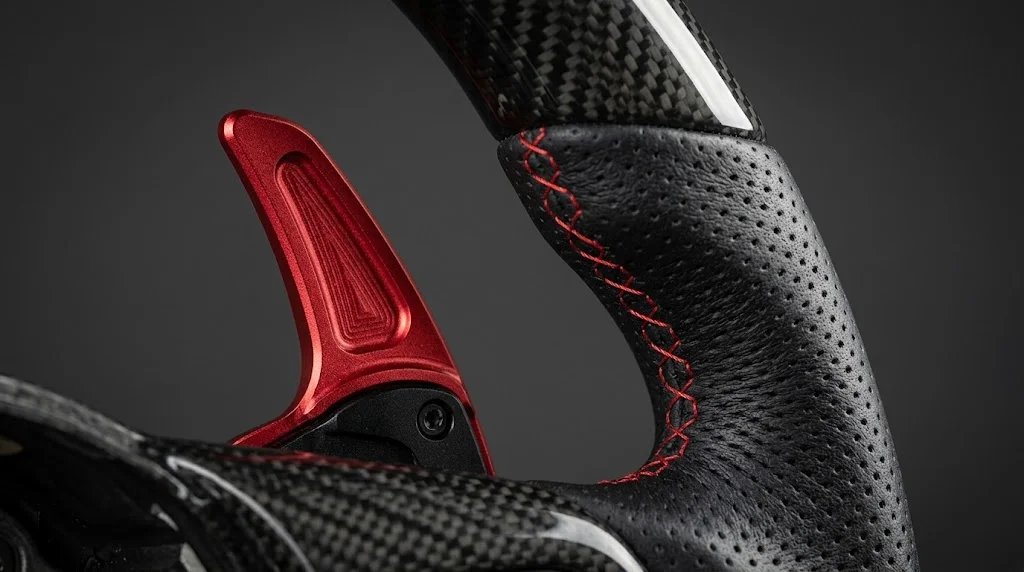
Shapes differ more than owners expect. The GR Supra uses a slim paddle mounted close to the rim, while some comfort-oriented Toyotas use a broader paddle on a longer arm. The mounting points and the sweep of that arm decide whether an existing set can be reused on a rebuilt wheel.
When a set is reused, the cut-out follows the original position exactly, so the reach is unchanged. When a different shape is wanted, the arm and the mount are considered together. This is settled before the covering is cut.
Adding paddles to a car that never had them is possible on some Toyotas and not on others. It depends on the transmission, the control unit and whether the wiring harness carries the connections. The paddle itself is simple. What supports it is not.
On a car that already has the wiring, the upgrade is close to a straight swap. Without that wiring, the work can grow beyond the value it adds. We describe the outcome as conditional for that reason, and we will say plainly when the honest answer is to leave the car alone.
The covering has to work around the cut-out. Leather takes the shape cleanly, and perforated leather adds grip where fingers reach past the rim. Carbon is normally kept to the upper and lower sections, away from the opening.
Stitching is chosen at order, and it can be matched to the trim the car already uses. A twelve o'clock stripe is optional. Because the segments are cut before the covering is stitched, the material layout is settled before any work starts. A cut-out that follows the original line keeps the wheel looking as though it left the factory that way.
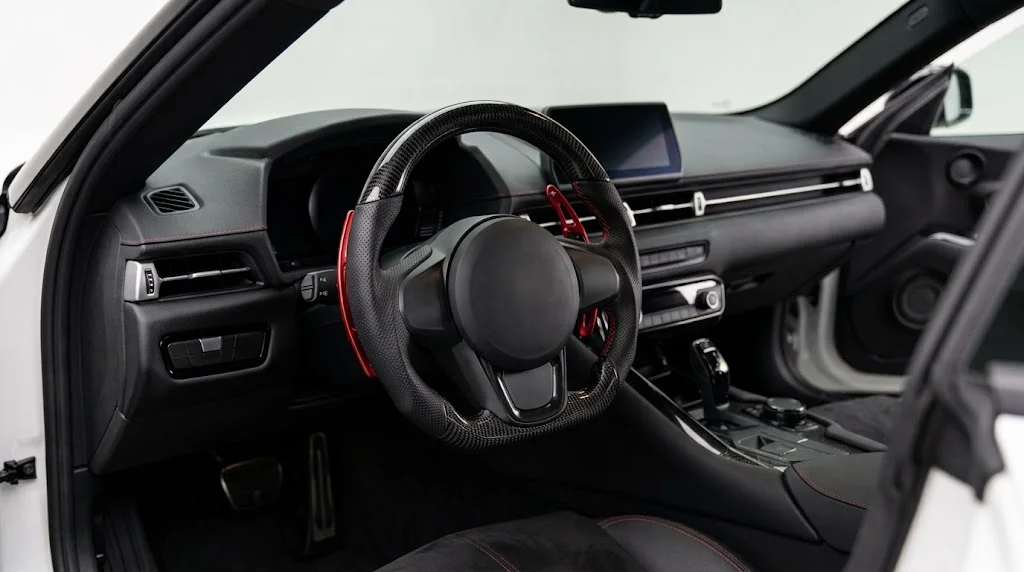
Start with the chassis number and the full option list. Add a daylight photograph of the wheel face, one of its rear with the airbag removed, and one showing the paddles and their connectors. Whether a Toyota paddle shifter upgrade suits your car turns on those details.
Cars of the same year can carry different wheel frames. The photographs show us the spoke profile, the button pods and the paddle mounts. We cut nothing until the match is confirmed, and we will ask for a clearer picture rather than guess.
A new covering should not cost you a working switch. Our builds reuse the frame and the wiring already fitted to your car.
| Function | Typical outcome |
|---|---|
| Airbag | Original module normally reused; cover shaped to suit it |
| Multifunction buttons | Retained when the original button frame is reused |
| Paddle shifters | Retained where fitted; the cut-outs are set at order |
| Heated rim | Depends on the heating element and trim; confirm first |
| Toyota Safety Sense | Depends on the hands-on detection in the original wheel |
The heating mat and the hands-on sensor sit behind the rim. Each needs its own photograph, and neither can be judged from the front face.
A paddle upgrade raises its own coding question. Where the transmission, the module and the car-specific wiring reuse what the vehicle already has, further coding may not be needed. A gearbox that never supported paddles is a different case.
That varies from vehicle to vehicle, so coding stays a possible step rather than a promise. Send the chassis number with photographs of both electronic units, and we will say whether a workshop visit looks likely.
Problems with a paddle upgrade rarely come from the covering. They come from the electronics. A car without the right harness may support the paddles physically and not electrically. Paddle shapes also change between model years, even within one generation. A wheel built for a different gearbox can leave the paddles present but inactive. A heated rim added without the matching module creates the same kind of dead end. Each of those cases shows up in the photographs before an order is accepted.
The first week tells you whether the position suits your hands. Most drivers find the paddles sit naturally once the rim is thicker, because the fingers reach less far. Owners who never use them still notice the improved grip on the rim itself.
The first long drive settles the question of reach. A set mounted too far forward is noticed on every gear change, while a position matched to the original wheel disappears from thought entirely.
Cleaning follows the same routine as any retrim. A microfibre cloth and a mild soap handle carbon and leather, and a soft brush lifts the nap on Alcantara. Keep solvents away from the stitching and from the seams around the cut-out.
Sometimes. It depends on the transmission, the control unit and the wiring your car carries. Photographs of the connectors tell us what is possible.
They keep working. The switch and its wiring are reused, and the new covering is cut around the original mounts.
Only for a donor build. A newly made core leaves your factory wheel with you.
No. The upgrade changes the wheel, not the software, so the transmission behaves exactly as it did before.
Expect ten to fifteen working days for the build, then fifteen to twenty days for delivery. From order to arrival, the total sits between twenty-five and thirty-five days.
Yes, with a newly made core. Your original wheel stays in the garage and can go back on the car at any time.
They do. A pull on the paddle overrides the selected ratio briefly, and the transmission returns to its own programme once the driver stops using them. Nothing about the gearbox programme itself is altered.
If the original paddle is reused, its finish stays as it was. The covering around it is what changes, and the two are matched at order.
A Toyota rim ordered here is made for one car only. There is no finished stock behind the catalogue. Our Guangzhou workshop cuts, stitches and assembles each wheel after the order is confirmed. That work draws on thirteen or more years of engineering, design and hands-on production. Paddles, stitch and covering are yours to choose, and each is matched to your chassis before work starts. Orders go out tracked worldwide, carry a three-year warranty, and can come back within thirty days through an RMA request.
Two other guides on this site answer the questions that follow this one. The heated retrofit guide deals with the wiring side of a wheel upgrade, which follows the same logic as paddles. The shape guide compares flat-bottom and round rims, which matters once a cut-out is involved. The full range sits in the shop, and the Toyota pages are the brand listing and the GR Supra page.
Photograph the wheel and the paddles, add the chassis number and the option list, and send them across. We will reply with a confirmed build and a date before we make your Toyota paddle shifter upgrade. Two wheels in the catalogue suit this range. The first is the carbon fibre wheel listed for the Land Cruiser and the GR Supra A90. The second is the piano black wheel that covers the Land Cruiser, Supra A90 and Corolla.
A little further reading may help. The installation guide takes you through the battery and airbag stages, while the FAQ covers what owners ask us most. An about page gives the workshop background if you want it. Questions about fitment or shipping can be raised on the inquiry form or via the contact page. Delivery windows are set out in the shipping policy, and returns are governed by the return and refund policy. The warranty position is set out in 15 U.S.C. 2304, and air bag requirements appear in 49 CFR 571.208.
From the battery cable to the clock spring: how a Toyota steering wheel installation runs, the airbag steps that cannot be skipped, and the checks before a test drive.
Read More →Measure your Toyota steering wheel in a minute, compare the result with the standard ranges, and see what diameter does to feel before you order a custom rim.
Read More →How a heated steering wheel retrofit works on a Toyota, from the Camry and RAV4 to the Corolla: wiring, switches, coverings and what to check first.
Read More →