
The Toyota Steering Wheel Installation Guide
From the battery cable to the clock spring: how a Toyota steering wheel installation runs, the airbag steps that cannot be skipped, and the checks before a test drive.
Read More →Guide · 10/5/2026
Gloss carbon, Alcantara or perforated leather for your Toyota wheel? How each material grips, ages and copes with heat, and where each belongs on the rim.
Toyota sells the same wheel to a Corolla commuter, a Camry family saloon and a GR Supra. All three sets of drivers ask the same question before ordering: which material should go on the rim? The answer depends on climate, hand chemistry and how the car is driven. This guide compares the three finishes we build most often for Toyota models, in plain terms. Every Toyota steering wheel materials order starts with one question: how will the car be used?
Almost every Toyota order we take comes down to gloss carbon, Alcantara or leather. Each one wins on a different criterion, and the table below sets out the trade-offs before the detail.
| Material | Grip | Heat | Upkeep | Best for |
|---|---|---|---|---|
| Gloss carbon | Low, decorative only | Warms quickly in sun | Wipe down, shows dust | Visual upgrade with leather grips |
| Alcantara | Highest of the three | Stays cool, resists glare | Brush every few weeks | Spirited driving, dark cabins |
| Perforated leather | High and predictable | Vents air at the palms | Balm twice yearly | Daily driving in warm weather |
None of the three is wrong. The mistake is choosing one for the wrong reason, so the sections below explain what each actually does over years of use.
Most first orders begin with colour. A Toyota steering wheel materials decision should follow from use, not from a photograph. That is the wrong order. Material decides how the wheel feels every morning, how it copes with a hot afternoon, and how much attention it needs. Colour and stitching are the easy parts to change at order time, and they cost nothing extra.
Toyota's own finish is smooth leather on most models, with Alcantara reserved for the GR cars. Matching that baseline is the safe route. Moving away from it is a deliberate choice, and it should follow from how you use the car rather than from a photograph.
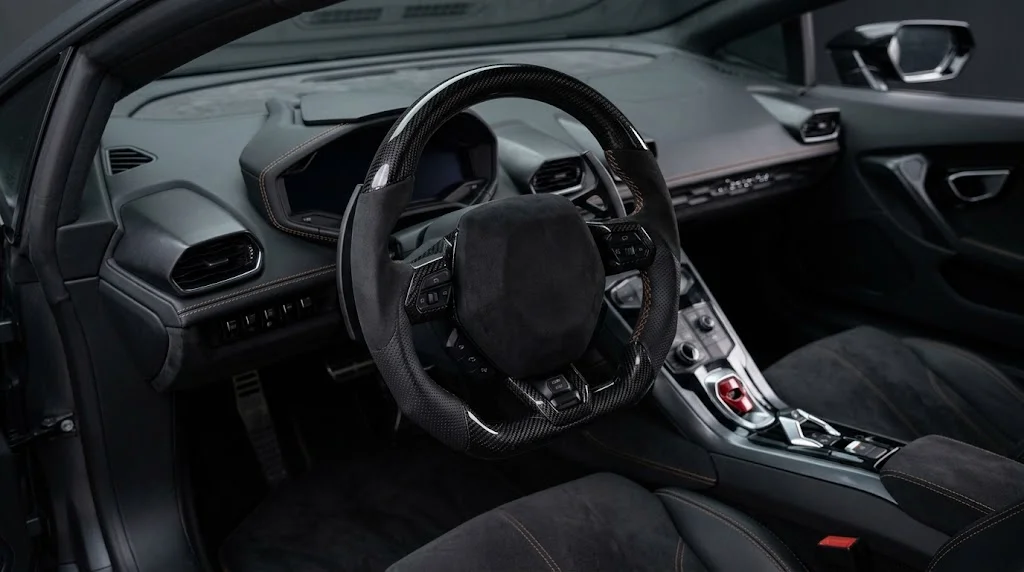
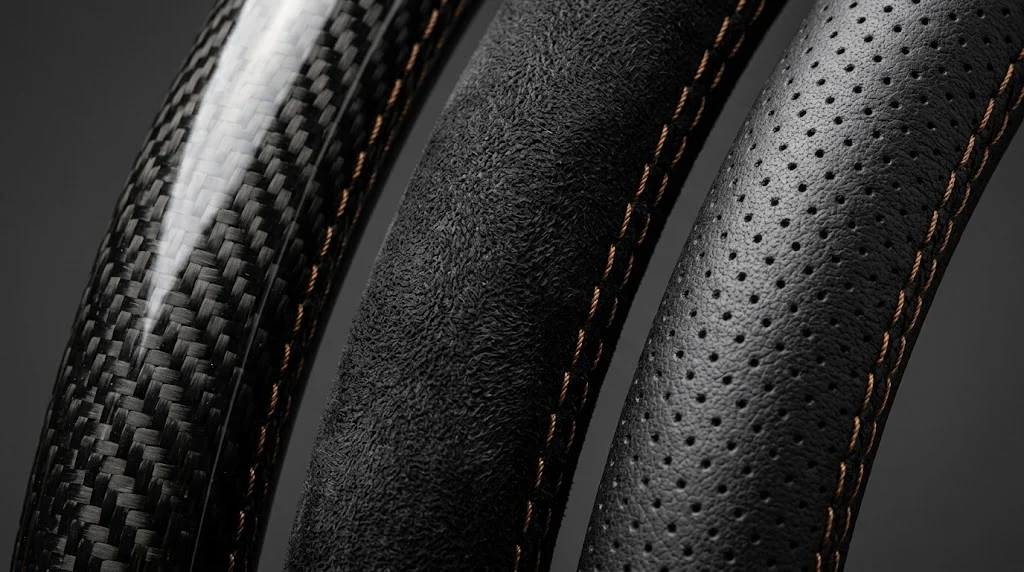
For a Toyota steering wheel materials order, carbon is the visual option rather than the practical one. A woven pattern runs along the upper and lower rim and catches light as you turn, which lifts an otherwise plain dashboard. The coating is durable and wipes clean easily. It is not a grip surface, though, and a rim finished entirely in carbon becomes unpleasant once the cabin is hot. The sensible specification pairs carbon with leather on the grips.
Alcantara is the performance option. It holds the hands better than leather in every condition, and it reflects almost no light, which matters on a low winter sun. The cost is maintenance: bare hands leave oils in the nap, so it needs a gentle brush every few weeks rather than a wipe. Drivers who push the car accept that trade without hesitation.
Perforated leather is the practical option for most Toyota owners. It vents air where the palms sit, copes with wet mornings and cleans up with a damp cloth. A balm twice a year keeps it supple, and it ages in a way that still looks intentional after five years. Smooth leather is the closest match to the factory finish, while perforated leather adds ventilation.
Material is only half the order. We still need the chassis number and the full options list. Add a daylight photograph of the wheel face, and a photograph of its rear with the airbag out. Whether a Toyota steering wheel materials specification will suit your car depends on getting those details right first.
That set tells us the spoke profile, the button cluster and the plug type. The Camry, Corolla and the GR range all use different frames, so the model matters as much as the year. We cut nothing until the match is confirmed, and we will ask for a clearer photograph rather than assume.
Changing the finish should not disable a switch. Our builds reuse the frame and wiring already in your Toyota.
| Function | Typical outcome |
|---|---|
| Airbag | Original module normally reused; cover built to suit it |
| Multifunction buttons | Retained when the original button frame is reused |
| Paddle shifters | Retained on automatic cars that have them |
| Heated rim | Depends on the heating element and trim; confirm first |
| Toyota Safety Sense | Depends on the hands-on detection fitted to the original wheel |
Both the heating element and the hands-on sensor sit behind the rim, and each needs its own photograph before we can confirm anything.
Position matters as much as choice. Carbon belongs on the twelve and six positions, where hands rest least and light falls most. The suede belongs at nine and three, where grip is generated. Leather works anywhere, which is why it is the default for the whole rim on a daily driver. Bronze stitching along the seam ties the three together. On a round rim the transition between materials sits under the palm, so the seam should feel smooth rather than raised. Ask us for a photograph of the seam if that detail matters to you.
Whichever material you choose, an airbag sits in the middle of the job. Give the work to someone qualified. Disconnect the battery and let the car power down fully before loosening anything. Follow Toyota's procedure for your chassis rather than a general guide. Lay the module on something soft, and set the centre fastener to the figure printed in the workshop manual. Nothing else should be trusted for that number.
Afterwards, drive a short distance and check that the rim is centred. Work through the buttons, any paddles and the horn. A warning lamp that stays on means the car needs a scan before further driving.
Warranty questions follow every modification. An aftermarket steering wheel does not automatically void a vehicle warranty under U.S. federal warranty law, but warranty coverage can still depend on whether the modification caused the specific failure being claimed.
Coding depends on the car, not on the material. Where the original module, the wiring and the vehicle-specific components are reused, further coding may not be required. A module from a different generation is another matter, and the control unit may then need to be told what is fitted.
Because that varies between cars, we describe coding as a possible step rather than a certainty. Send the chassis number with images of both electronic units and we will say whether a workshop visit looks likely.
Most problems we hear about come from a fitment mismatch rather than a material fault. A wheel from a neighbouring generation often shares the badge but not the button frame. A heated rim on a car that never had one leaves an unused plug and a control with nothing to do. Safety systems depend on sensing hardware inside the factory rim, so replacing it can raise warnings. A cover shaped for a GR airbag arriving on a Corolla is the quiet cosmetic failure. The four checks above clear all of them.
The right Toyota steering wheel materials for your car depend on climate and use. Climate settles much of the argument. Coastal owners often ask about salt and humidity. Perforated leather copes better there than suede, because it dries faster and does not hold grit. In a hot, humid region, perforated leather or Alcantara will feel better than smooth leather for most of the year. In a cold one, smooth leather warms faster and needs the least attention. If the car is parked outside, carbon will show dust and leather will show less. If it lives in a garage, the visual appeal of gloss carbon costs you almost nothing.
Leather lasts longest with the least attention. Alcantara wears well but needs brushing, and carbon trim outlasts both as long as the clear coat is not abraded.
Yes, and owners of GR models often do. Carbon at twelve and six, Alcantara at nine and three, and leather along the lower rim is a common combination.
No. It stays cooler than smooth leather and does not become slippery, which is why performance models use it.
Only for a donor build. A newly made core leaves your factory wheel with you.
Ten to fifteen working days in production, then fifteen to twenty days for shipping. Expect twenty-five to thirty-five days in total.
Tell us the colour you want and we will match it as closely as the thread range allows. Bronze and grey are the two most common requests.
Every rim is cut, stitched and assembled at our own plant in Guangzhou. Thirteen or more years of design and production experience sit behind the current patterns, and nothing begins until an order arrives. Material, stitch and shape are your decisions; each one is checked against your chassis before cutting starts. Orders ship tracked worldwide, with a three-year warranty and thirty days for returns via an RMA request.
Our Hilux guide covers Toyota's pickup line and the materials that survive dusty work, and most of what is described here appears there too. The full range sits in the shop, and the Toyota pages are Toyota fitment, the Camry listing and the Corolla listing.
Tell us which material you are leaning towards, add the chassis number and the options list, and send a photograph of the wheel. We will reply with a confirmed build and a date before we make your Toyota steering wheel materials order. Three catalogue entries cover the finishes compared here. The first is the carbon fibre wheel for the Corolla, Camry, Crown, Prius, Supra and RAV4. The second is the nappa leather wheel for the same range. The third is the forged carbon version.
Plenty more reading exists if you want it. The installation guide covers the battery and airbag sequence, and the
From the battery cable to the clock spring: how a Toyota steering wheel installation runs, the airbag steps that cannot be skipped, and the checks before a test drive.
Read More →Measure your Toyota steering wheel in a minute, compare the result with the standard ranges, and see what diameter does to feel before you order a custom rim.
Read More →How a Toyota paddle shifter upgrade works, from the GR Supra and GR86 to the Camry and RAV4: fitment, wiring, coverings and what to check before ordering.
Read More →